
How to Choose the Right Ultrasonic Cleaner for Your Laboratory
In this article
Published by ArkanLabs · Cover image is illustrative
Ultrasonic cleaners offer an effective way to remove dirt, oils and residues from laboratory tools and components that are difficult to clean using conventional methods. They are particularly useful for compatible items with small openings, recessed surfaces and complex shapes.
With a wide range of tank sizes and operating features available, choosing the right ultrasonic cleaner depends on the laboratory's applications, the dimensions of the items being cleaned and the required cleaning process.
How Does Ultrasonic Cleaning Work?
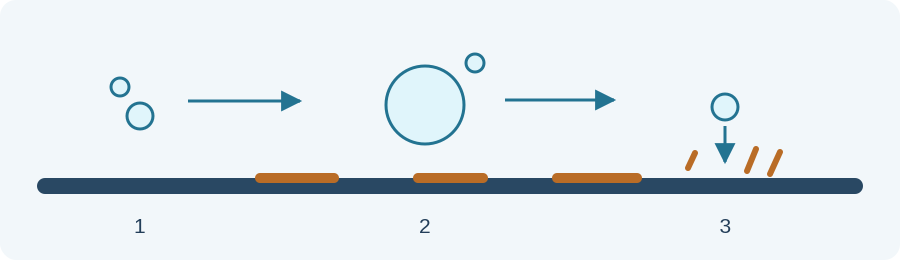
Ultrasonic cleaners transmit high-frequency sound waves into a cleaning solution, creating microscopic bubbles that rapidly collapse. This process helps loosen contaminants from surfaces, including areas that may be difficult to reach with a brush.
Known as acoustic cavitation, this phenomenon is the fundamental principle behind ultrasonic cleaning technology.
Applications of Ultrasonic Cleaners in Laboratories
Ultrasonic cleaning is used across scientific, industrial and medical laboratory environments for applications such as:
- Cleaning compatible metal tools and laboratory instruments.
- Removing oils, grease and accumulated residues.
- Cleaning components with intricate shapes and small openings.
- Cleaning selected equipment components during maintenance.
Always confirm that the materials and cleaning solution are suitable for ultrasonic cleaning. Ultrasonic cleaning is not a substitute for validated disinfection or sterilization procedures.
Key Features to Consider When Choosing an Ultrasonic Cleaner
Tank Capacity
Tank capacity is one of the most important considerations when selecting an ultrasonic cleaner.
Smaller units are suitable for compact tools and components, while larger tanks provide additional space for bigger items or multiple components.
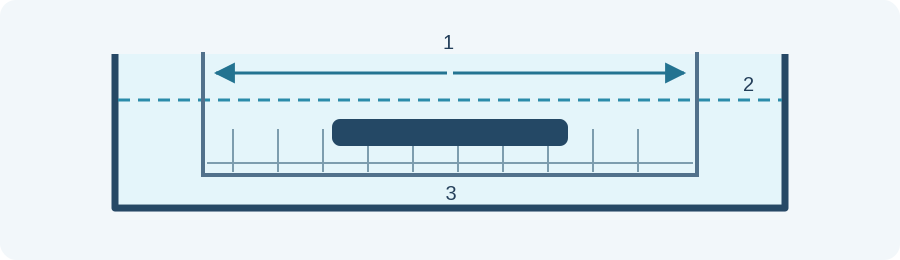
In addition to nominal capacity, check the internal dimensions of the tank and basket to ensure they accommodate the items being cleaned.
Ultrasonic Frequency
Operating frequency influences the characteristics of the cleaning process. A frequency of 40 kHz is suitable for many general cleaning applications, while higher frequencies may be appropriate for certain delicate components.
The appropriate frequency depends on the material, contaminant and cleaning requirements.
Temperature Control
Some ultrasonic cleaners feature integrated heaters that allow users to control the temperature of the cleaning solution.
Heating may improve cleaning performance in certain applications, but it is not necessary for every process. Always consider the compatibility of the cleaning solution and the items being cleaned.
Digital Timer
A digital timer allows users to control cleaning duration and repeat established cleaning cycles with consistent time settings.
Degassing Function
A degassing function helps reduce dissolved gases in a freshly prepared cleaning solution before ultrasonic cleaning begins.
Comparing Branson Ultrasonic Cleaners
The Branson CPX series offers digital ultrasonic cleaning baths equipped with adjustable timers and degassing functions.
The CPX3800-E and CPX5800-E provide different tank capacities, allowing laboratories to select a model based on their cleaning requirements and available bench space.
| Specification | CPX3800-E | CPX5800-E |
|---|---|---|
| Nominal tank capacity | 5.7 L | 9.5 L |
| Internal tank dimensions | 290 × 150 × 150 mm | 290 × 240 × 150 mm |
| Ultrasonic frequency | 40 kHz | 40 kHz |
| Digital timer | 1–99 minutes | 1–99 minutes |
| Continuous operation | Yes | Yes |
| Degassing function | Yes | Yes |
| Integrated heater | No | No |
| Manufacturer part number | CPX-952-339R | CPX-952-539R |
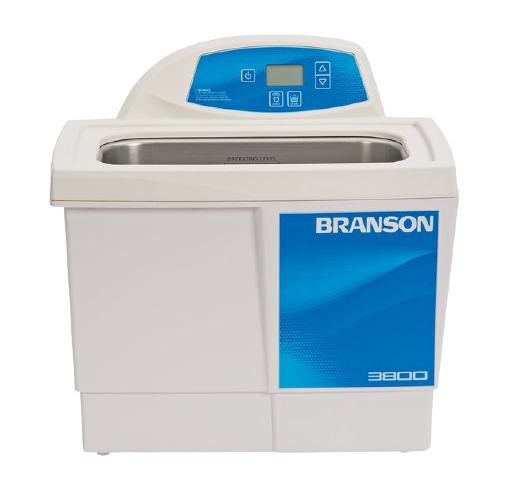
Branson CPX3800-E — 5.7 L
A digital ultrasonic cleaning bath suitable for smaller tools and components that fit within its usable basket dimensions. It features adjustable operating time and a degassing function.
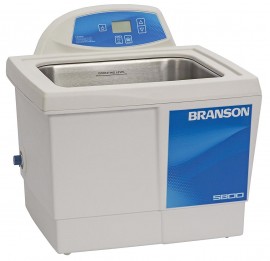
Branson CPX5800-E — 9.5 L
This model offers a wider tank, providing additional space for laboratories that need to clean larger or wider components.
Tips for Effective Ultrasonic Cleaning
- Select a cleaning solution compatible with the materials being cleaned.
- Use a suitable basket instead of placing items directly on the tank floor.
- Avoid overcrowding the basket to maintain access to the surfaces being cleaned.
- Follow the manufacturer's recommended operating liquid level.
- Follow the equipment manufacturer's operating and maintenance instructions.
Laboratory Ultrasonic Cleaners at ArkanLabs
ArkanLabs supplies ultrasonic cleaners in a range of capacities and configurations to support scientific, industrial and medical laboratory applications.
Explore our product range, compare technical specifications or contact our team for assistance in selecting an ultrasonic cleaner that meets your laboratory's requirements.
Explore Laboratory Ultrasonic Cleaners